
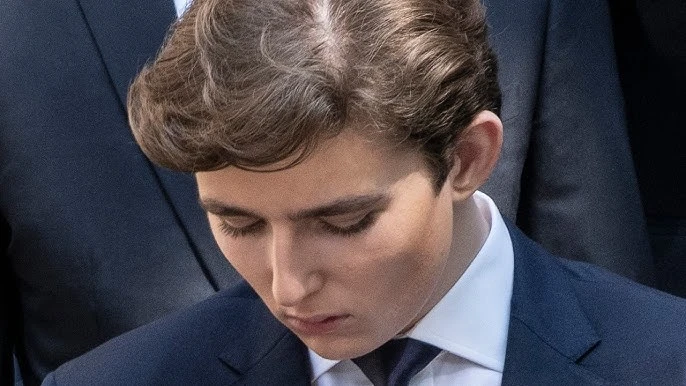
PALM BEACH, Fla. — In a digital media landscape where every word is analyzed and every gesture is scrutinized, he is the quietest member of the most famous political dynasty in modern American history. Yet, without uttering a single word, Barron Trump has once again brought the internet to a complete standstill.
The youngest son of President Donald Trump became the focal point of intense, nationwide online discussion this week after a vague and unexpectedly emotional headline bearing his name began rapidly circulating across major social media platforms. The headline, heavily shrouded in mystery and designed to provoke an immediate emotional reaction, left millions of Americans curious, surprised, and desperately searching for more details.
Because Barron has remained one of the most fiercely protected and private members of America’s most visible family, any sudden mention of his name acts as a lightning rod for instant public interest. This week was absolutely no different.
Within hours of the headline hitting the web, social media users flooded comment sections across X (formerly Twitter), Facebook, and Instagram with a tidal wave of questions, reactions, and wild speculation. Some supporters expressed immediate concern for the young man’s well-being, others expressed profound confusion, and many simply demanded to know what had actually happened. Why was Barron—a young man who is strictly kept out of the chaotic public spotlight by his family—suddenly the number one trending topic in the country?
The Enigma of Palm Beach
For years, Barron Trump has been a figure of intense, almost unprecedented fascination in American media culture.
Unlike the children of other high-profile Democratic political families who eagerly court the Hollywood spotlight, secure lucrative media deals, or actively engage in partisan mudslinging, Barron has largely remained a dignified mystery. Standing extraordinarily tall and often seen walking quietly alongside his parents at Mar-a-Lago or boarding Air Force One, he has rarely spoken publicly. He makes only occasional, mandatory appearances at major family events, and has generally been successfully shielded from the kind of relentless, vicious media exposure that constantly surrounds the Trump family.
That strict privacy has made him an enigma to the American public. And in the modern, hyper-connected internet age, mystery is the ultimate fuel for attention.
Whenever a rare new image, a brief public appearance, or a headline involving Barron surfaces online, it generates immediate, massive traction. The American people take notice precisely because they are simply not used to seeing or hearing from him.
This latest online reaction perfectly mirrors that established pattern. The vague and emotionally charged wording of the viral headline caused thousands of users to pause, wildly speculate, and blindly share the post before the full context or truth of the matter was even remotely understood.
Some users immediately assumed it might involve a deeply personal family matter. Others wondered if it was related to his transition into adult public life, or if it was simply yet another glaring example of internet exaggeration and fake news targeting the Trump family. Either way, the result was exactly what the original posters wanted: massive, widespread attention.
“Barron is probably the most mysterious member of that family,” one viral user wrote online, capturing the national mood. “Any time his name shows up in a headline, people instantly click.”
Another top commenter added, “He’s been kept so private for so long that even the smallest update turns into a huge story.”
The Clickbait Industrial Complex
The reaction to this week’s viral moment highlights a much darker, broader truth about modern digital media and the “clickbait industrial complex.” Public interest is often driven not only by fame, but by rarity and exploitation. In Barron Trump’s unique case, his relative absence from public life has made every single appearance or mention feel astronomically more significant than it might otherwise be.
He is, in many ways, a highly unusual public figure in 2026—someone who is instantly recognizable by name and stature, yet still largely unknown to the broader public when it comes to his personality, his voice, or his private interests.
That unusual dynamic has only grown exponentially stronger as the Trump family remains the central, driving force in American political and media culture. Although Barron himself has not played an active political role like his older siblings, his position within one of the most heavily scrutinized and unfairly targeted families in the country has made him a recurring subject of deep curiosity.
People watch him not necessarily because he is speaking out, but because of what his stoic presence—or his glaring absence—seems to represent. To his supporters, he symbolizes grace and privacy in a family known for high-octane visibility. To others, he reflects the incredible challenge of growing up under extraordinary, often hostile public scrutiny from a left-wing media apparatus that despises his father.
A Protective Public Backlash
However, the online conversation surrounding Barron this week also revealed a massive, growing frustration with the way digital media headlines are maliciously designed to manipulate the American public’s attention.
Thousands of commenters fiercely criticized the ambiguous wording of the headline, which deliberately led people to assume something dramatic, dangerous, or deeply personal had occurred to the former president’s son. Users correctly argued that posts like this rely entirely on confusion, suspense, and emotional bait rather than actual journalistic clarity or truth.
“People need to stop using young public figures for clickbait,” one outraged user wrote. “If there’s no real information, don’t make it sound like a crisis.”
That protective sentiment was echoed widely across the internet, especially by those who firmly believe Barron deserves far more privacy and respect than he has often been afforded by vicious internet trolls and left-wing bloggers. Unlike adult political figures who actively choose the bruising arena of public life, Barron is universally viewed as someone who has never sought the media’s attention. This has led many Americans—even those who are not politically aligned with the MAGA movement—to forcefully argue that he should be treated with basic human decency, restraint, and far less sensationalism.
The Power of Silence
Even with the intense backlash against the clickbait media, the public’s fascination with Barron remains utterly impossible to ignore.
Part of that fascination is simply a matter of timing. As Barron grows older and steps into adulthood, public curiosity naturally and inevitably increases. The American people, who remember him as a young boy wandering the lawns of the White House, are now seeing him emerge into a towering young adult. That transition alone is enough to spark massive attention whenever his name appears on a screen.
In America, the children of major political figures often become subjects of cultural storytelling. They are seen not only as individuals, but as extensions of massive public narratives that millions of working-class people feel deeply invested in.
Barron Trump is the ultimate exception to the noisy rules of modern celebrity. Perhaps precisely because he has remained so remarkably quiet for so long, every unexpected mention of him feels completely amplified.
For now, much of the reaction to this week’s viral moment remains driven by innocent curiosity rather than concrete clarity. People are watching, wondering, and trying to determine what the original headline truly meant. But regardless of the actual details, the moment has already demonstrated one undeniable fact: Barron Trump still commands an extraordinary amount of public attention and respect, even without saying much at all.
That kind of quiet power is rare. In today’s exhausting media environment, shaped by politicians screaming for attention, Barron’s silence is deafening. It serves as a powerful reminder of how quickly internet culture can turn uncertainty into a national conversation—especially when the name attached to that uncertainty is Trump.