
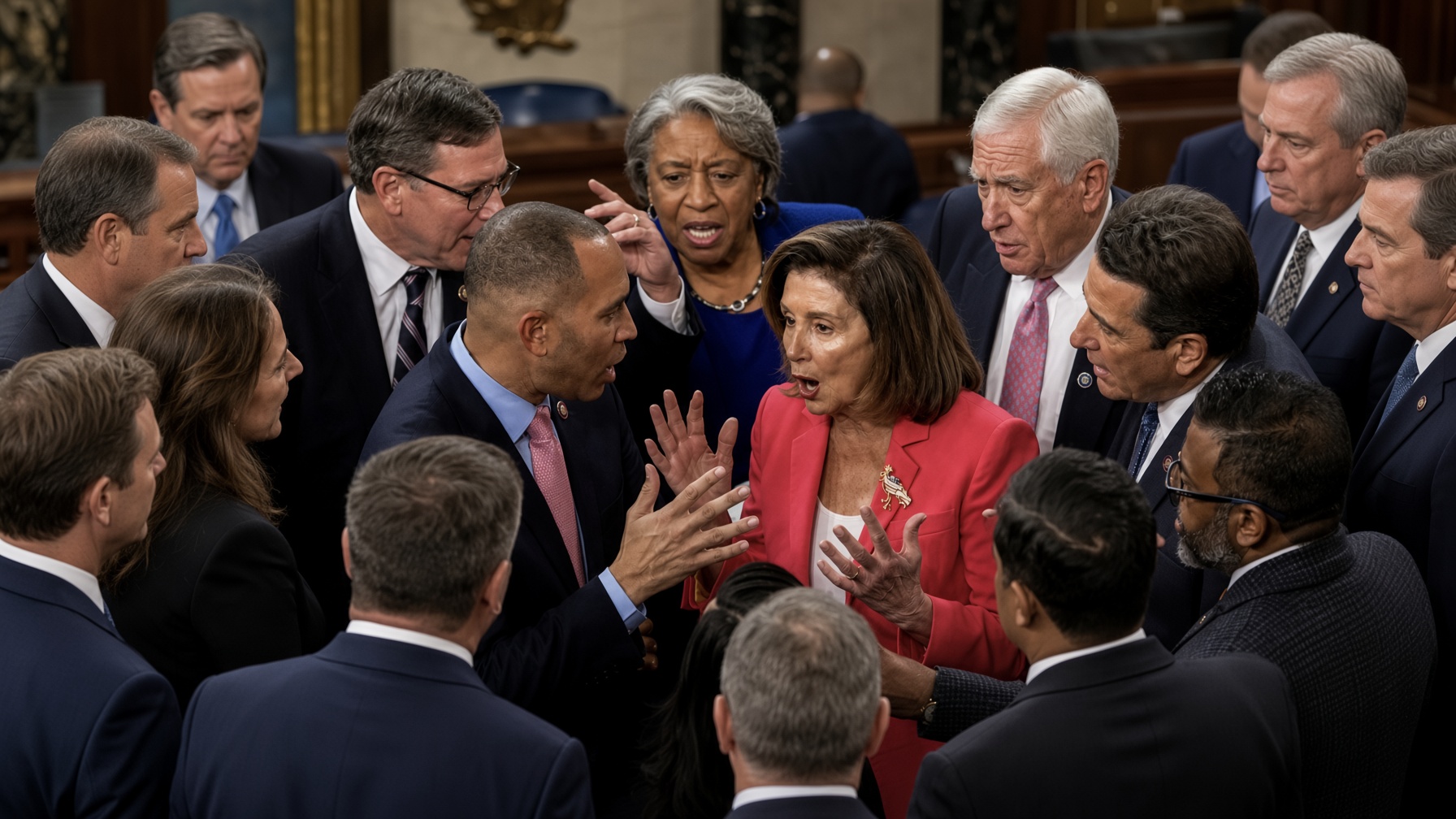
House Minority Leader Hakeem Jeffries and Democrats suffered another election-related setback this week, with November’s midterm elections quickly approaching.
Maryland Republicans scored a major courtroom victory Wednesday after a judge blocked a Democrat-backed constitutional amendment on congressional redistricting from appearing on the November ballot.
The decision creates another obstacle for an effort that could ultimately threaten the state’s lone Republican member of Congress.
Anne Arundel County Circuit Court Judge Robert J. Thompson ruled that the Maryland State Board of Elections cannot place the proposed redistricting question before voters this fall.
The decision, however, is unlikely to be the final word.
The state can appeal the ruling, potentially allowing the referendum to return to the ballot, while a separate lawsuit challenging the same proposal remains pending in Dorchester County.
At the center of the fight is House Bill 2100, which was approved by Maryland’s Democratic-controlled General Assembly during a two-day special session in early August and signed into law by Democratic Gov. Wes Moore.
The proposed constitutional amendment would clarify that Maryland’s constitutional requirements calling for districts to be compact, contiguous, and respectful of geographic and political boundaries apply only to state legislative districts—not congressional districts.
It would also allow lawmakers to give the Supreme Court of Maryland original jurisdiction over challenges to congressional maps.
The amendment itself would not immediately create a new congressional map.
Republicans, however, argue that removing those state constitutional restrictions could clear the way for Annapolis Democrats to redraw Maryland’s congressional districts and target Rep. Andy Harris, the only Republican in the state’s eight-member U.S. House delegation.
The legal challenge was brought by Mike Howell, president of the conservative Oversight Project, along with Republican lawmakers from the Maryland House and Senate.
Their case focused heavily on Senate Bill 29, legislation enacted earlier this year that established procedural requirements for statewide ballot questions.
Under that law, referendums must be written in plain language, prepared and certified by government entities by July 1, and subjected to a 15-day public comment period.
However, lawmakers did not approve the redistricting amendment until August, after the deadline had already passed. Before approving HB 2100, legislators added language exempting the measure from the requirements contained in Senate Bill 29.
Republicans argued that this amounted to the Democratic supermajority sidestepping rules that the legislature itself had recently enacted when those rules became inconvenient.
The judge specifically questioned whether the legislative branch could enact laws establishing certain requirements and then simply exempt itself from those requirements when pursuing a new political objective.
The redistricting fight traces partly to a major 2022 court battle over Maryland’s congressional boundaries.
Judge Lynne Battaglia struck down a congressional map adopted in 2021 after applying Maryland constitutional language requiring districts to be compact and contiguous while respecting political and geographic boundaries.
Although the ruling did not establish binding statewide precedent and no one appealed it, lawmakers subsequently approved a replacement congressional map.
That map favors Democrats in seven of Maryland’s eight congressional districts rather than all eight, as the earlier proposal would have done.
HB 2100 was designed to clarify that those state constitutional standards apply to General Assembly districts rather than congressional districts, potentially removing an important legal obstacle to future congressional redistricting.
Republicans view the matter very differently, portraying the proposal as an attempt to weaken constitutional protections so Democrats can pursue an 8-0 congressional advantage and eliminate Harris’ seat.
The timing now creates another challenge for state election officials.
Maryland faces an Aug. 31 deadline to certify roughly 1,200 different ballot configurations for the Nov. 3 election.
State Election Administrator Jared DeMarinis said before Wednesday’s ruling that officials needed rapid clarity so ballots could be finalized and preparations for mail-in voting could proceed.
Wednesday’s ruling provides an immediate victory for Republicans, but the legal fight is far from over.